
The Netherlands is on track to reach 79.9 GW of installed solar PV capacity by 2035, according to new projections from UK-based research and consulting firm GlobalData. The company expects the Dutch market to add 4.5–5.5 GW of new solar capacity annually over the next decade.
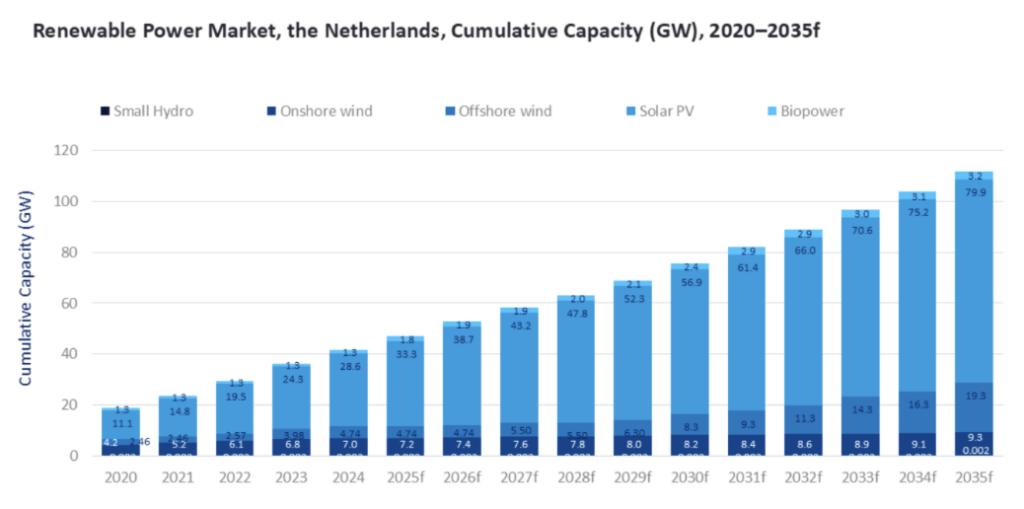
GlobalData’s latest analysis shows that the Netherlands will add 4.7 GW of PV capacity in 2025, bringing total installations to 33.3 GW. An estimated 5.4 GW is expected in 2026, followed by 4.5–5 GW of annual additions through 2035. At this pace, Dutch PV capacity is forecast to surpass 50 GW in 2029, reach 75 GW in 2034, and approach 80 GW by the end of 2035.
Solar PV is expected to remain the country’s largest renewable energy source throughout the coming decade. GlobalData anticipates the Netherlands’ total renewable energy capacity to climb from 41.6 GW in 2024 to 111.7 GW in 2035, representing a compound annual growth rate (CAGR) of 9.4%.
According to GlobalData power analyst Mohammed Ziauddin, government policies—including the SDE++ renewable subsidy scheme and the National Energy and Climate Plan (NECP)—continue to play a central role in driving growth. He noted that although the Netherlands is working to ease grid constraints through TenneT’s grid reinforcement strategy and the national congestion action plan, grid congestion remains a major obstacle.
Additional challenges weighing on the renewable energy market include curtailment risks, negative power prices, rising network fees, slow energy-storage deployment, and difficulties in securing suitable locations for new wind and solar projects. Ziauddin emphasized that with rapid solar expansion, steady onshore wind growth, and a strong offshore wind pipeline, the Netherlands is positioned to build a significantly larger renewable energy system by 2035. However, grid modernization, flexibility investments, and streamlined permitting will be essential to convert project pipelines into operational capacity.
In October, the Dutch government announced plans to replace the SDE++ subsidy mechanism with a two-way Contracts for Difference (CfD) scheme to align with EU power market reforms. A month earlier, the Ministry of Climate and Green Growth and the Ministry of Housing and Spatial Planning proposed amendments to the Environmental Decree to accelerate permitting for transmission and distribution projects above 21 kV.

it is currently one of the largest exporters of photovoltaic products in China.
 IPv6 network supported
 English